In the early part of the 14th century A.D., following the demise of King Mayura Varma and the ensuing political instability in the Pandya Kingdom, widespread unrest prevailed across the region. Seeking peace, security, and stability, many Tamil Brahmin families migrated from Tamil Nadu to various parts of Kerala.
These migrations took place through different routes. Some families entered Kerala through Pollachi and settled in Palakkad and surrounding areas. Others travelled via Nagercoil to Thiruvananthapuram, while another group crossed through Aryankavu and settled in Kollam. From these centres, they gradually dispersed and established settlements throughout Kerala.
Committed to preserving their religious traditions, rituals, customs, and way of life, these Brahmin families established Agraharams — traditional Brahmin settlements organized around temples. These Agraharams became vibrant centres of spiritual, cultural, and social life, helping the community maintain its identity in a new land.
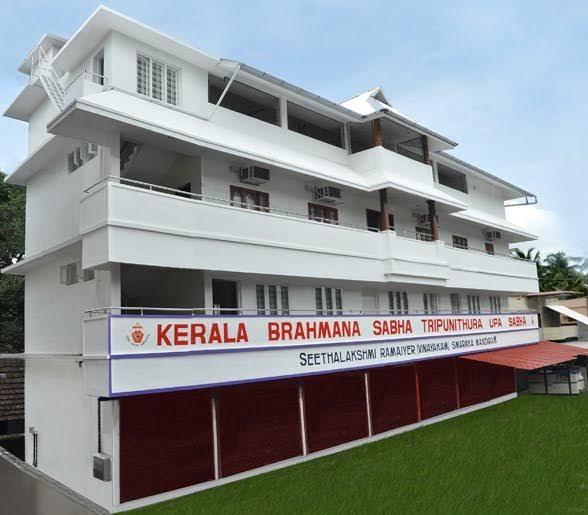
As the number of Agraharams increased, the need for a common meeting place where members of the community could gather, interact, discuss matters of common interest, and conduct religious and social activities became evident. It is believed that during the early years of the 18th century, the Tamil Brahmins residing in these Agraharams conceived the idea of establishing Samooha Madoms (Community Halls).
These Samooha Madoms served as centres for community interaction, religious discourses, Vedic studies, cultural activities, and the accommodation of travelling members of the community. In most parts of Kerala, they were strategically established in close proximity to the principal temples of the town or village, thereby reinforcing the strong bond between temple worship and community life.
Over time, the Samooha Madoms evolved into important institutions that fostered unity among Tamil Brahmins living across Kerala and played a significant role in preserving their heritage, traditions, and social cohesion for generations.
With the support and patronage of the rulers of the time, nearly 250 Samooha Madoms were established across Kerala. These institutions were known by various names such as Samooha Madom, Gramajana Samooham, and Grama Samooham, reflecting their role as centres of community life and social cohesion.
Generous benefactors and community patrons endowed these institutions with extensive paddy fields and agricultural lands to ensure the regular conduct of religious observances, rituals, and community activities. The income derived from these endowments enabled the smooth organization of important religious functions and festivals such as Sasthapreethi, Bhagavathy Seva, Navarathri, Ratholsavam, Upakarma, and other traditional observances.
Beyond organizing these community-based events, the members of the Samooha Madoms played a prominent role in the religious and cultural life of their respective localities. They actively participated in and often spearheaded the conduct of festivals and ceremonies associated with the presiding deities of local temples. Through their dedication and collective effort, these institutions became vital centres for preserving religious traditions, promoting cultural values, and fostering unity among Tamil Brahmin families settled across Kerala.
Recognizing the need to unite the numerous Samooha Madoms functioning across the erstwhile Travancore State, Sri V. P. Madhava Rao, the then Diwan of Travancore, took the initiative to bring these institutions under a common organizational framework. This effort received strong support from Sri Anantharama Iyer, who was serving as the Pavusari Commissioner at the time.
As a result of these efforts, The Travancore Brahmana Sabha was established in 1946. The founding office-bearers included Justice K. Sankara Subbayyar as President, Sri K. S. Nataraja Sarma and Sri K. Sivaramakrishna Sastrigal as Secretaries, and Sri S. Sankara Subbayyar as Treasurer. The Sabha was guided and supported by eminent patrons such as Sri Haripad Krishna Iyer, Perumbavur Sri G. Narayana Iyer, and Sri T. V. Ramasubbayyar, founder of the renowned newspaper Dinamalar.
The activities of the Travancore Brahmana Sabha extended throughout the erstwhile Travancore Kingdom, from Kanyakumari in the south to North Paravur in the north. The Sabha served as a unifying platform for the Brahmin community and the various Samooha Madoms within its jurisdiction.
One of its notable initiatives was the publication of “Dharma Prakasika,” a periodical that disseminated religious, cultural, and community-related information. The publication reached a large number of Samooha Madoms and played a significant role in fostering communication and unity among community members.
At the General Meeting held in 1949 under the chairmanship of Sri K. S. Ramaswamy, who held the title of Diwan Bahadur, a landmark decision was taken to expand the Sabha’s activities beyond Travancore and serve the Brahmin community across South India. Reflecting this broader vision, the organization was renamed Dakshina Bharatha Brahmana Sabha.
Although this expansion marked an ambitious new chapter in the Sabha’s history, its activities gradually declined in the years that followed.
A historic milestone in the collective journey of the Tamil Brahmin community in Kerala was achieved on 8th and 9th May 1965, when a Maha Sammelan of representatives from Samooha Madoms across the State was convened at Kalady. The gathering was graced by the presence of the Jagadguru Sankaracharyas of Sringeri Sharada Peetham, Dwarka Sharada Peetham, and Govardhan Math, lending immense spiritual significance and prestige to the event.
The Sammelan witnessed the participation of several distinguished leaders and eminent personalities of the Tamil Brahmin community, including Sri Mavelikara S. Kulathu Iyer, Sri Chidambara Krishna Iyer of Thiruvananthapuram, Sri N. S. Mony of Perumbavur, Dr. Hari, Sri N. Subrahmanya Iyer, Sri N. R. Sreenivasan Iyer, Sri P. Veeraraghavan, Sri T. S. Krishnamoorthy, Sri C. M. Devan, Sri K. S. Paripoornan, and many other respected community leaders from different parts of Kerala.
While the Sammelan primarily focused on matters concerning the welfare, unity, and cultural preservation of the community, an important discussion emerged on the need for establishing a state-wide organisation that could represent and coordinate the activities of Tamil Brahmins throughout Kerala.
Initially, there were reservations regarding the necessity of creating another organisation, as numerous Samooha Madoms, Gramajana Samoohams, and similar community bodies were already functioning effectively in various regions of the State. Some felt that a new organisation might duplicate existing efforts or diminish the autonomy of these traditional institutions.
However, through extensive deliberations and the constructive efforts of community leaders, a consensus gradually emerged. The discussions at Kalady ultimately paved the way for the formation of a state-level organisation for Tamil Brahmins in Kerala.
Accordingly, on 17 August 1970, the All Kerala Brahmins’ Association (AKBRA) was formally registered under the Travancore-Cochin Literary, Scientific and Charitable Societies Registration Act, XII of 1955, bearing Registration No. S. No. 60 of 1970.
The formation of the Association was made possible through the dedicated efforts and leadership of eminent community members such as Sri S. S. Warren, Sri Sivaraman, Sri Vechoor S. P. Iyer, and several other visionaries who recognized the need for a unified organisation to represent and serve Brahmins across Kerala. A significant milestone in the growth of the Association was the Annual General Meeting held in 1972, which witnessed the participation of delegates from various districts of Kerala. The enthusiastic response and statewide representation reflected the growing acceptance of the Association as a common forum for the Brahmin community across the State. o strengthen communication and disseminate information on community affairs, culture, traditions, and organisational activities, the Association launched its official mouthpiece, “Vipra Sandesh,” in 1975. The publication soon became an important medium for connecting members across Kerala.
The establishment of the All Kerala Brahmins’ Association marked a new chapter in the history of Kerala’s Brahmin community.
A significant turning point in the history of the All Kerala Brahmins’ Association (AKBRA) came in 1980, when its Annual General Meeting was conducted at Alappuzha, marking the first occasion on which the Association's annual conference was held outside Thiruvananthapuram. This development symbolized the Association’s growing reach and its commitment to serving Brahmin communities throughout the State.
At this meeting, Sri N. Narayana Swamy, Advocate, was elected as the State President. Under his leadership, the Association continued its efforts to strengthen organizational unity and expand its activities beyond its traditional areas of influence.
The momentum gathered further at the 1981 Annual General Meeting, held at Kottayam, where Sri V. Raghavan (Kottayam) was elected President and Sri T. N. Gopalakrishnan (Thiruvananthapuram) assumed office as General Secretary. The new leadership team brought renewed energy and vision to the Association’s activities.
Through their dynamic and dedicated efforts, the Association expanded its organisational network across Kerala. Unit-level and district-level committees were established in several regions, including the northern districts of the State, thereby extending the Association’s presence far beyond its original strongholds in southern Kerala.
While the All Kerala Brahmins’ Association was steadily expanding its activities across the State, another important organisation, the Brahmana Sabha, Palakkad, had been actively functioning in Palakkad since 1978. The existence of these two organisations, both working towards the welfare and advancement of the Brahmin community, highlighted the need for greater coordination and unity at the state level.
A historic breakthrough was achieved on 15 January 1983, at a General Meeting held in Kottayam, when the Brahmana Sabha, Palakkad and the All Kerala Brahmins’ Association resolved to work together under a common banner. This landmark decision led to the birth of the Kerala Brahmana Sabha (KBS), marking the beginning of a new era of unity and collective action among Kerala’s Brahmin community.
The formation of the Kerala Brahmana Sabha represented the culmination of decades of efforts aimed at bringing together the various Samooha Madoms, Gramajana Samoohams, local Sabhas, and community organisations functioning throughout Kerala. It provided a unified platform to preserve cultural and religious traditions, promote social and educational welfare, and strengthen the bonds among Brahmin families across the State.
Subsequently, at the General Meeting held in Ernakulam in April 1983, the first Executive Committee of the Kerala Brahmana Sabha was elected. Sri N. N. Ramachandran was chosen as the first President, while Capt. V. S. Moni Iyer assumed office as the General Secretary.
Under the leadership of this pioneering team, the Kerala Brahmana Sabha embarked upon the task of building a strong statewide organisation capable of representing the aspirations and interests of the Brahmin community throughout Kerala. The establishment of the Sabha marked a significant milestone in the community’s history, creating a common forum that could coordinate activities, foster unity, and preserve the rich cultural and spiritual heritage inherited from generations of Agraharams, Samooha Madoms, and earlier community organisations.
President Desk
The All Kerala Brahmins’ Association, popularly known today as the Kerala Brahmana Sabha (KBS), was established and registered in 1970 under the Travancore-Cochin Literary, Scientific and Charitable Societies Registration Act, 1955. The organisation was founded with the objective of bringing together Brahmins across Kerala on a common platform, fostering unity and collective progress while preserving their rich cultural and spiritual heritage and also to promote and safeguard traditional values, encourage the study and propagation of the Vedas and the Sanskrit language, and protect the legitimate rights and interests of its members.
In 1983, the All Kerala Brahmins’ Association merged with the Brahmana Sabha, Palakkad. This historic merger brought together two prominent community organisations and led to the formation of the Kerala Brahmana Sabha (KBS), creating a unified statewide body representing Brahmins throughout Kerala. Following the merger, the Kerala Brahmana Sabha expanded its organisational network across all 14 districts of Kerala, establishing district, unit, and local committees.
Today, as the Kerala Brahmana Sabha (KBS) celebrates more than five decades of dedicated service, it has emerged as one of the most prominent and influential community organisations in Kerala. Over the years, the Sabha has evolved into a vital institution committed not only to preserving the rich traditions, culture, and spiritual heritage of the Brahmin community but also to promoting social welfare and safeguarding the legitimate rights and interests of its members.
Through a wide range of humanitarian, educational, cultural, and charitable initiatives, the Sabha has made a meaningful and lasting impact on the lives of thousands of families across the State. Its activities are guided by the principles of service, compassion, and community empowerment.
Among its major welfare initiatives are:
- Educational assistance and scholarships for deserving students from economically weaker sections.
- Financial aid and relief measures for families facing hardship.
- Medical assistance and healthcare support, including help with hospitalization expenses.
- Distribution of essential provisions, including rice and other necessities, to underprivileged families.
- Recognition and encouragement of excellence in education, culture, sports, and other fields by nurturing and rewarding talented individuals.
- Support for the solemnization of marriages of girls from financially disadvantaged families.
- Assistance in conducting funeral rites and post-death ceremonies, ensuring that families facing financial difficulties can perform these important religious obligations with dignity and respect.
In addition to its welfare activities, the Sabha has played a significant role in strengthening community bonds and fostering a sense of collective identity among Brahmins residing in different parts of Kerala and beyond. To promote greater interaction and unity among members worldwide, the organisation has successfully conducted two Global Meets, hosted in Ernakulam and Palakkad. These landmark gatherings brought together community members from across India and abroad, providing a platform for cultural exchange, networking, and discussions on issues relevant to the community.
A key focus of the Sabha's future roadmap is the promotion of entrepreneurship and economic self-reliance within the community. To achieve this, the Sabha aims to create a common marketing and networking platform that will connect entrepreneurs, professionals, and business owners. It also seeks to support the development, promotion, and marketing of products and services created by community members, while facilitating the establishment and growth of Micro, Small and Medium Enterprises (MSMEs) and other business ventures. In the field of healthcare and social welfare, the Sabha plans to establish healthcare units, palliative care centres, and sanatoriums to cater to the medical and rehabilitative needs of the community, particularly the elderly and those requiring long-term care. The Sabha also remains deeply committed to supporting vulnerable and economically disadvantaged sections of the community. Its future plans include initiatives to:A key focus of the Sabha's future roadmap is the promotion of entrepreneurship and economic self-reliance within the community. To achieve this, the Sabha aims to create a common marketing and networking platform that will connect entrepreneurs, professionals, and business owners. It also seeks to support the development, promotion, and marketing of products and services created by community members, while facilitating the establishment and growth of Micro, Small and Medium Enterprises (MSMEs) and other business ventures. In the field of healthcare and social welfare, the Sabha plans to establish healthcare units, palliative care centres, and sanatoriums to cater to the medical and rehabilitative needs of the community, particularly the elderly and those requiring long-term care. The Sabha also remains deeply committed to supporting vulnerable and economically disadvantaged sections of the community. Its future plans include initiatives to:A key focus of the Sabha's future roadmap is the promotion of entrepreneurship and economic self-reliance within the community. To achieve this, the Sabha aims to create a common marketing and networking platform that will connect entrepreneurs, professionals, and business owners. It also seeks to support the development, promotion, and marketing of products and services created by community members, while facilitating the establishment and growth of Micro, Small and Medium Enterprises (MSMEs) and other business ventures. In the field of healthcare and social welfare, the Sabha plans to establish healthcare units, palliative care centres, and sanatoriums to cater to the medical and rehabilitative needs of the community, particularly the elderly and those requiring long-term care. The Sabha also remains deeply committed to supporting vulnerable and economically disadvantaged sections of the community. Its future plans include initiatives to:A key focus of the Sabha's future roadmap is the promotion of entrepreneurship and economic self-reliance within the community. To achieve this, the Sabha aims to create a common marketing and networking platform that will connect entrepreneurs, professionals, and business owners. It also seeks to support the development, promotion, and marketing of products and services created by community members, while facilitating the establishment and growth of Micro, Small and Medium Enterprises (MSMEs) and other business ventures. In the field of healthcare and social welfare, the Sabha plans to establish healthcare units, palliative care centres, and sanatoriums to cater to the medical and rehabilitative needs of the community, particularly the elderly and those requiring long-term care. The Sabha also remains deeply committed to supporting vulnerable and economically disadvantaged sections of the community. Its future plans include initiatives to:
- Provide housing assistance and shelter for homeless and destitute families.
- Establish and operate care centres for financially challenged individuals and senior citizens.
- Expand charitable and welfare programmes aimed at improving quality of life and ensuring social security for those in need.
Guided by the principles of inclusiveness, service, and collective progress, the Kerala Brahmana Sabha envisions becoming not only a guardian of tradition but also a catalyst for social, economic, and cultural advancement
"Preserving Heritage, Promoting Welfare, and Empowering Future Generations" remains the guiding vision of the Kerala Brahmana Sabha as it continues its journey of service to the community and society at large.
In the meantime, the “Brahmana Sabha, Palakkad” had started functioning in the Palakkad District since 1978. On 15th January 1983, at the General Meeting held at Kottayam, when the Brahmana Sabha Palakkad and the All Kerala Brahmins’ Association decided to work together, the Kerala Brahmana Sabha came into existence. At the General Meeting held at Ernakulam in April 1983, the first Executive Committee of the Kerala Brahmana Sabha was elected with Sri. N.N. Ramachandran as President and Capt. V.S. Moni Iyer as General Secretary.